

A solid—but not groundbreaking—subscription-free smart ring
The Noise Luna Ring Gen 2 is a thoroughly solid wearable that hits the high notes of sleep and readiness tracking without the burden of a monthly subscription. It doesn't attempt to reinvent the category, but, by refining the design and polishing the app experience, Noise has created a reliable Oura alternative for those who value core data. While it stops short of doing anything truly novel—and the four-day battery life is a genuine step back from class leaders—its overall accuracy and app make it a strong (if slightly too safe) contender.
Pros
- Stylish wave design stands out
- Friendly subscription-free app and AI coaching
- Can be paired with a charging case
Cons
- Disappointing 4-day battery life
- Large internal sensor bumps affect comfort
- Currently unavailable in the US
For years, the smart ring market has been a game of Oura vs. the rest. And while the Finnish brand has used its head start to build a subscription-walled fortress, a new wave of challengers—led by Samsung, Ultrahuman, and Noise—is betting that users are ready for change.
The question for these ring-makers is no longer just whether they can track a heartbeat, but whether they can offer a ‘complete’ enough experience to chip away at Oura’s dominance.
The Luna Ring Gen 2 is one of the latest attempts to answer that question.
Produced by Indian wearable giant Nexxbase/Noise, this second-generation device isn’t a radical departure from the original. It arrives with a slimmer profile, the option of a charging case, and a suite of AI-driven software updates designed to make sense of your data rather than just dumping it in a chart.
It positions itself as the practical alternative: a ring that looks roughly in line with premium competitors and provides generally accurate data without recurring costs. But in a market that is moving at breakneck speed, simply being solid might not be enough to steal the crown.
Price, subscriptions, availability, and competition
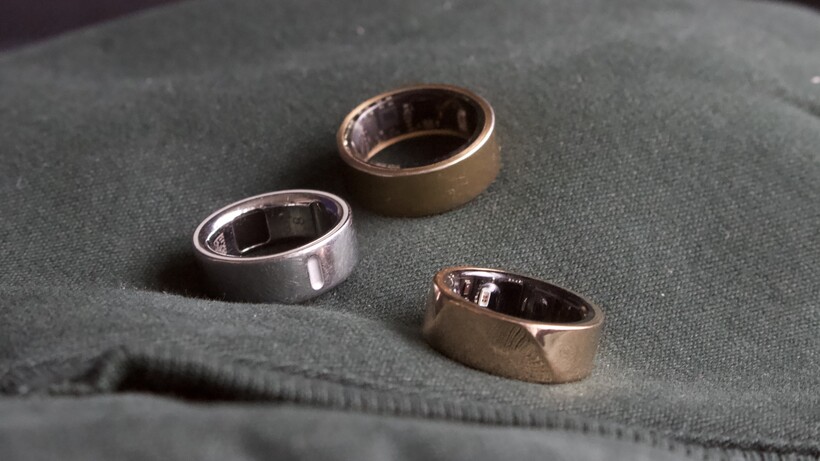
Like many of Oura’s true alternatives, the Luna Ring Gen 2 doesn’t come cheap. If you go off the company’s official pricing listed on its website—$299—it’s technically cheaper than the Oura Ring 4 (from $349), Samsung Galaxy Ring ($399.99), Ultrahuman Ring Air ($349), and the Circular Ring 2 ($349).
However, after Oura filed legal action against the parent company of the Noise Luna brand (Nexxbase) in November 2025, it appears to have been pulled from sale in the US for the time being. This isn’t quite the same scenario we’ve seen with Ultrahuman—where the Indian brand’s Ring Air remains, at the time of writing, under an import ban—but it’s still unavailable.
Availability complications aside, you can also buy the Luna Ring 2 with a dock charger ($300) or its charging case ($329), the latter raising the price.
That means it costs the same as the solid-performing RingConn Gen 2 ($299). There are cheaper smart rings out there. You can currently pick up the Amazfit Helio Ring for just $99—though, given our experiences with it, you’ll likely want to spend a bit more.
Like Samsung, Ultrahuman, and other brands away from the Oura bubble, you’re just paying for the hardware here. All of the data and insights available are free to access from the Luna Ring smartphone app, and that’s open to both Android and iOS users.
Design and comfort
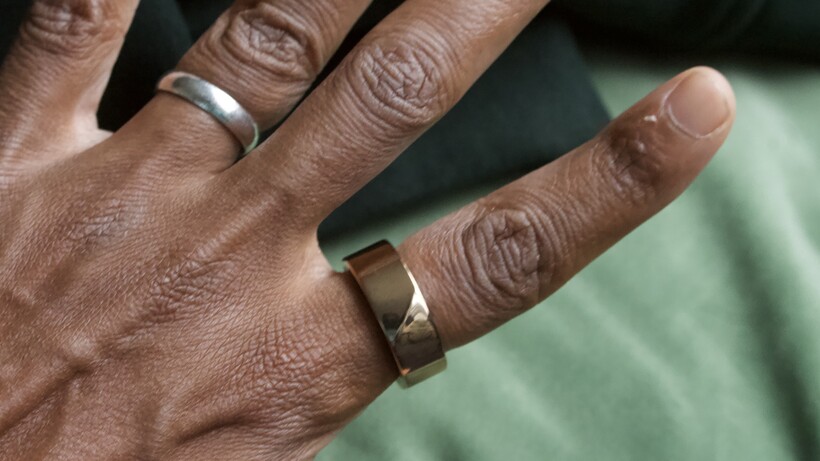
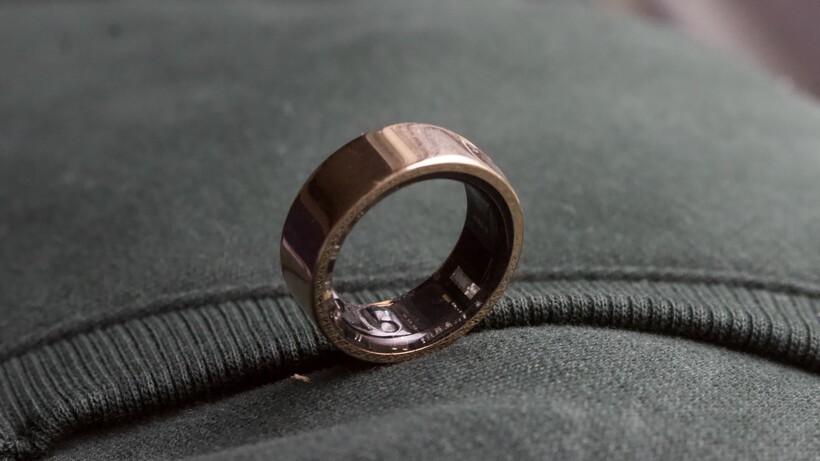
The Gen 2 gets a lot right for us in its design and wearability, and it’s a ring we felt comfortable wearing around the clock. Its thickness is comparable to the Oura Ring 4, which we’ve also been using. Weighing 3 to 5 grams, depending on size, it has a similar light feel to the Oura and other smart rings.
Made from titanium, the go-to material for smart rings, it’s both lightweight and durable. However, it can still get scratched—even if not as easily as other rings (like Ultrahuman’s or Oura) in long-term use. Like any other ring, we advise removing it when lifting weights or handling objects that could leave marks (or worse, leave you injured.
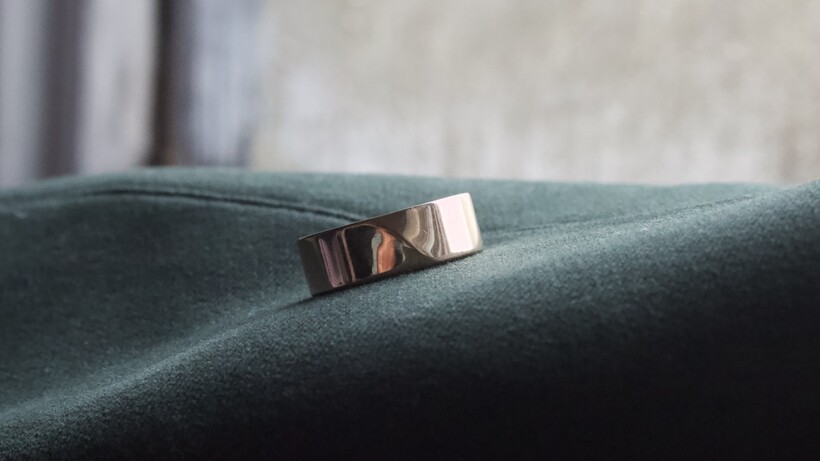
It’s also available in five different colours, including the vibrant sunlit gold we tested. We really like the wave design on the ring’s exterior, which makes the Luna stand out from other rings.
Holding steady
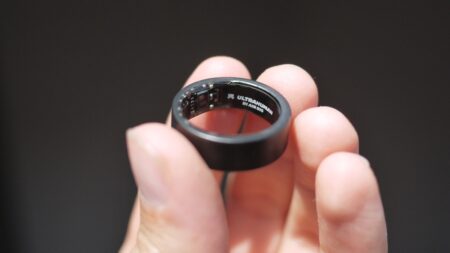
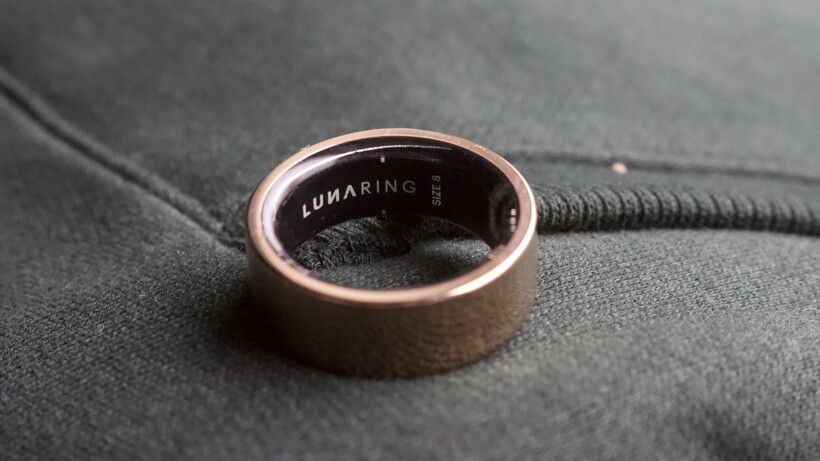
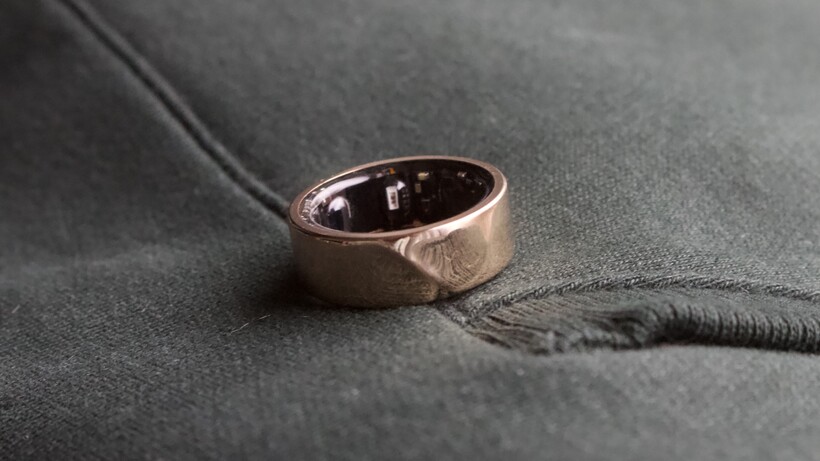
Inside, you’ll find the sensor bumps, which, unfortunately, isn’t quite as ‘disappearing’ as rival rings. It’s not unbearable to wear—and it does help ensure the ring doesn’t spin around your finger—but it feels a generation behind other devices in pure comfort.
Elsewhere, the Gen 2 also features a 5 ATM waterproof rating. That makes it suitable for submersion up to 50 meters. It’s not capable of tracking water-based activities like swimming, but it can at least survive a soak and continue tracking your time out of the water.
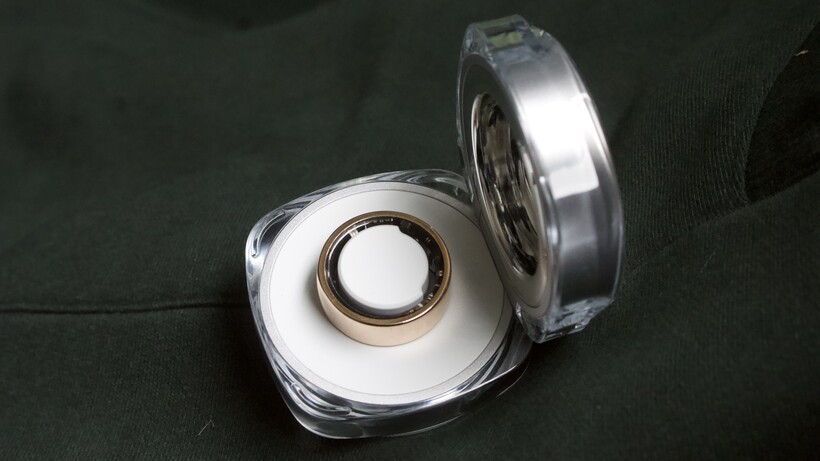
For Gen 2, Luna now allows you to charge your ring while on the go, too. You can pick it up using the brand’s ‘Surge’ charging case, which resembles those from brands like Samsung. A glowing ring encircles the charging dock to indicate remaining battery, while a smaller light in front indicates successful charging.
All in all, the Gen 2 ring doesn’t offer anything game-changing in terms of design—and it’s certainly not on par with the best the space has to offer. Yet, with the addition of a charging case and solid comfort, it does just enough to hold its own against rivals.
Battery life
The Luna Ring Gen 2 doesn’t offer the best battery life among smart rings. In fact, it remains mostly unchanged from Gen 1.
The maximum battery life is listed as up to 5 days, and our tests showed that daily and nightly use reduced the lifespan to around 4 days. This is much less time than that offered by competitors such as Samsung, Oura, RingConn, and others. In fact, it would even struggle to hold up against last-gen devices like the Oura Ring 3 in this area.
Noise tries to compensate with a charging case that can provide 30 days of power. And it certainly helps: the flat-to-full time is just over an hour, and the charging routine is nicer than with the first-gen ring. But it’s still not great for a ring that costs this much—compounded by the fact that many users may not opt to pay extra for the case.
Again, as we mentioned with something like the ring’s sensor bumps, it all just feels a bit outdated here. We’ve become used to rings that can last well over a week—and the smart ring’s wear-and-forget benefit just isn’t as strong here because of its short battery life.
Sleep tracking
One of the most compelling reasons to own a smart ring is that if you’re into tracking your sleep, this offers a way to do it that’s both comfortable and discreet. Wearing the Luna Ring to bed has been a surprisingly smooth experience—honestly, I barely noticed it. The LED lights inside the ring might shine a bit brighter than on other rings, but overall, it’s been completely unobtrusive when I go to sleep.
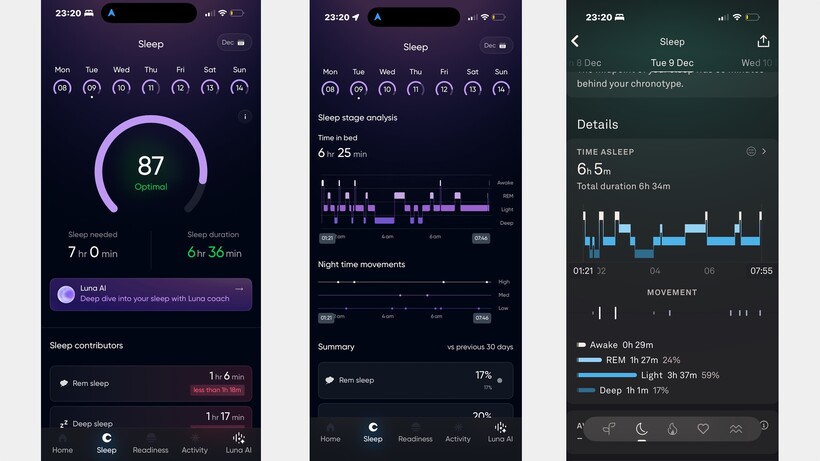
When you fall asleep, the array of optical sensors records common metrics typical of wearable sleep trackers. In the Luna Ring app, you’ll see an overall sleep score along with data such as sleep stages and total sleep duration. You can also turn to Luna’s AI chatbot to analyze your sleep patterns and get advice on the ideal bedtime.
Let’s start with the core sleep stats. We’ve been wearing two other sleep trackers alongside the Luna Ring, the Oura and a Garmin Forerunner 970.
When examining sleep and wake times, the data are very similar across devices. In terms of actual sleep duration, though, there was a slightly larger difference—approximately 15-30 minutes, depending on the night—across the devices.
Sleep stage data showed that the Luna Ring typically reported longer durations in deep sleep and REM stages, and sleep scores tended to be much more generous with the Luna Ring (we imagine as a result of this).
Still, given that sleep stage analysis is, by nature, a bit of a crapshoot even in the top sleep trackers, we felt we were obtaining good enough sleep data here. And, most importantly, there were no obvious errors in the data.
Feeding into a recovery dashboard
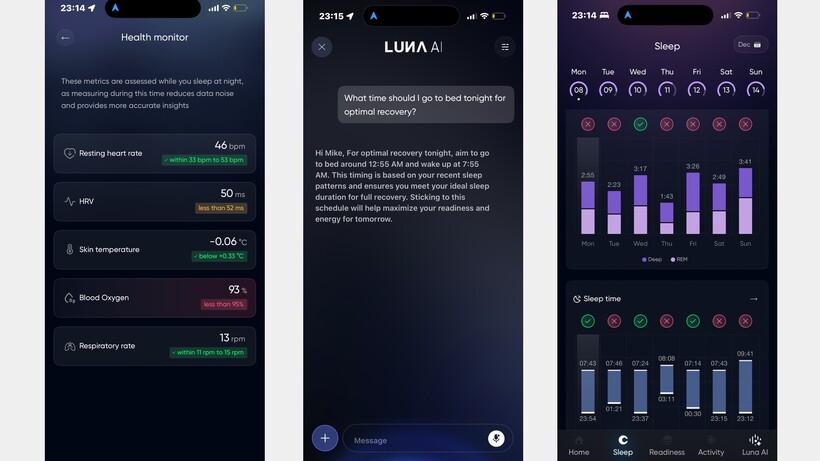
The platform’s health monitor actively tracks vitals such as resting heart rate, stress, SpO2, and skin temperature overnight, integrating additional sleep features.
This kind of feature has become increasingly commonplace in recent years—and this interpretation, in particular, mirrors the first ‘proper’ example: Whoop’s Health Dashboard.
It generally aligned with the insights from Oura and Garmin during our testing, showing dips in HRV and resting heart rate. However, like some less reliable trackers, SpO2 data did have the odd night of dipping to very low levels (while the metric remained in range on other devices.
Given this isn’t a feature that provides regulatory-approved insights, it’s worth following for some loose guidance, but probably nothing more.
You can also use Luna’s AI chatbot to ask questions like analyzing your sleep patterns or suggesting optimal bedtimes. It takes roughly 20 seconds to process queries. When we inquired about the best time to go to bed, the recommendation aligned with our usual bedtime, making it feel quite personalized, even if the chatbot’s presentation wasn’t great.
Fitness and activity tracking
The Gen 2 tracks your daily steps and automatically detects workouts, though it currently only recognizes walking and running. This data, combined with metrics such as resting heart rate and sleep, contributes to an overall readiness score.
But as with any smart ring, it’s not an out-and-out fitness tracker—more a device that can monitor the basics (or, if the platform allows, integrate data from platforms such as Strava and Apple Health).
Handling the basics
Examining the tracking data individually, such as daily step counts, reveals that the Gen 2 experienced both good and off days. On the good days, its step counts were typically within a few hundred steps of those recorded by other devices we used concurrently.
However, on certain days, it could be off by as much as 1,000 steps. Estimates for calorie burn and distance traveled showed similar variability—matching on some days and diverging on others.
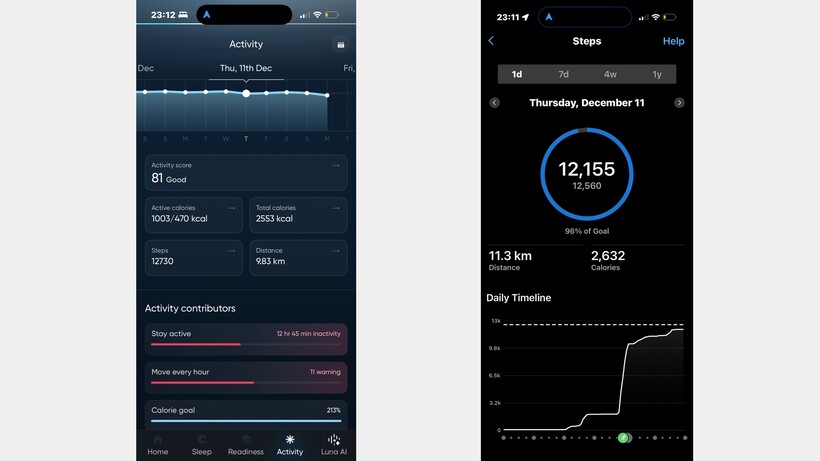
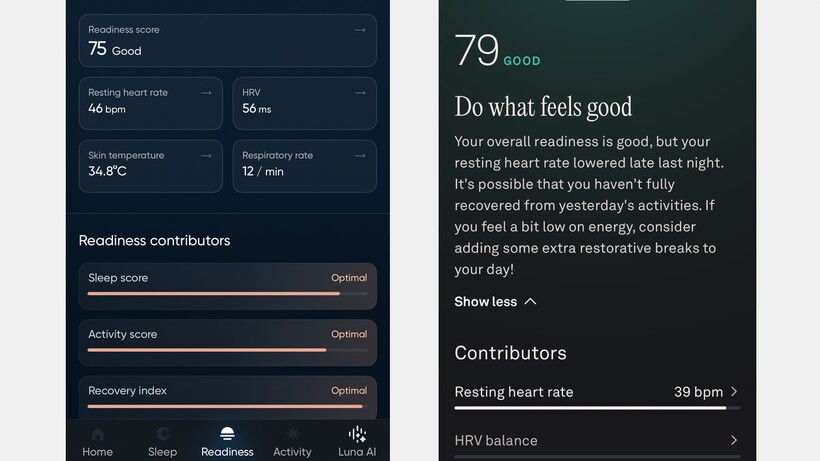
Oura also offers a Readiness score, so we kept an eye on how those scores compared. In general, they were the same, if not a few points off from each other.
In the Activity section of the app you can see if you’ve kept active throughout the day, see when you were most active during the day and see a record of recorded workouts.
The automatic workout detection for walks and runs appeared to function effectively. It was able to distinguish between running and strolling, although it may take about 10 minutes to register the activity, which means it doesn’t record the exact duration.
You can manually track workouts, but the data is reserved for heart rate monitoring only.
So, that means you can’t use your phone’s GPS to track outdoor workouts—and we often found it took a while for the app to register and display heart rate.
The Luna app experience
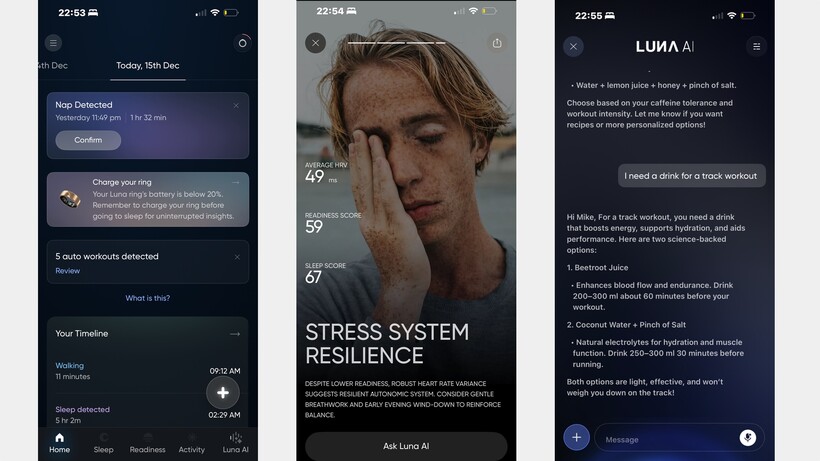
As we’ve learned from other smart rings we’ve worn, a robust companion app is essential to keep you engaged in the experience and wearing the ring full-time. It ties everything together and is as important as a ring that looks good, feels comfortable, and accurately tracks data.
Encouragingly, the Luna app incorporates some top features from both Oura and Ultrahuman. Its design and user interface are similar to those platforms, remaining very clean and polished.
The Ultrahuman influence is particularly evident in how features like Circadian alignment are displayed and in the tone of communication, such as gently reminding users when their caffeine window is closing. Derivative, perhaps, but it works.
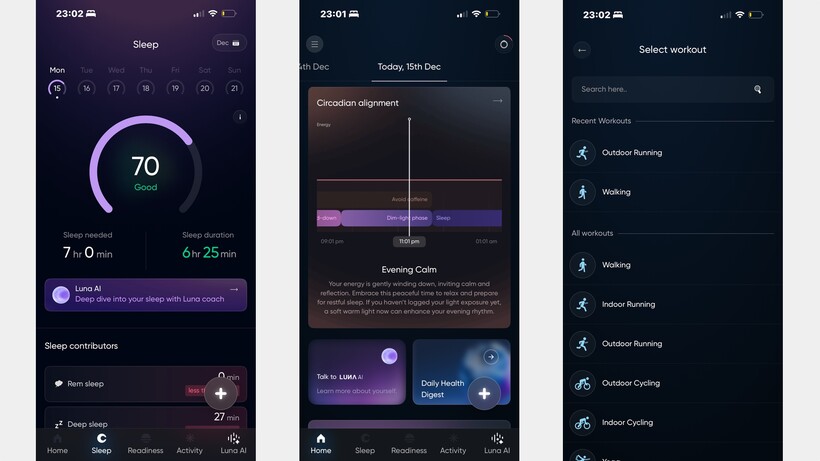
The app contains a substantial amount of information, but it’s well-organized into sections to avoid feeling overwhelming.
Consolidating the clutter
There’s a dedicated area for Luna’s AI coach, featuring tools like a daily health digest and options to create workout or nutrition plans. This section also offers advice on improving key metrics tracked by the ring, and gives the app a unique feel compared to other apps.
You’ll be pushed into the AI chatbot to handle these queries, where the bot can offer adaptable responses and serve as a useful resource for learning how to get the most out of your tracking. It’s a different experience to a platform we’ve criticized in reviews—RingConn’s—which can often feel overwhelming to interact with consistently.
You can share data with Apple and Google Health platforms to combine it with other health and fitness stats you’re monitoring. Again, we believe this is essential for the ring platform to gain a proper understanding of activities tracked from devices such as smartwatches and sports watches.
It can also be linked to the third-party menstrual cycle tracking app Clue, which gives it some semblance of a women’s health focus. However, those integrations—both for women and more broadly—lag behind those of Oura and Ultrahuman.